Rollei Infrared 400, a Mamiya 645 and a Very Long Wait
There is something slightly ridiculous about shooting infrared film.
With digital infrared photography, I can take a photograph and immediately have some idea whether what I imagined has actually happened. With film, there is none of that reassurance. I compose the photograph, meter the scene, calculate the exposure, put an almost opaque infrared filter over the lens and press the shutter.
Then I wait.
In the case of this particular roll of Rollei Infrared 400, I waited rather longer than expected.
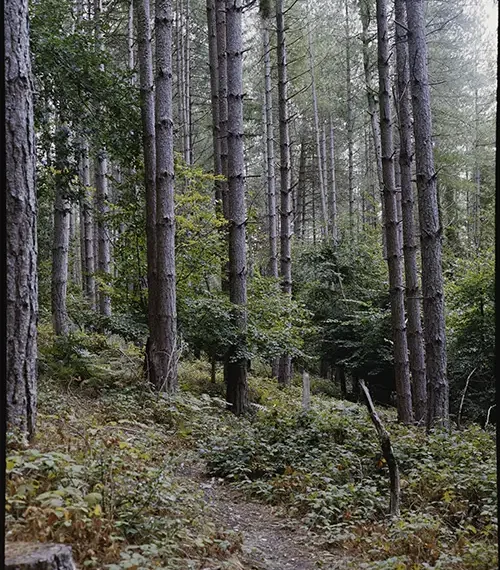
By the time the negatives eventually came back, I’d already shot another roll of film — Kodak Portra 400 in a local woodland — sent that away for processing and received it back.
In fact, I waited almost six weeks for these infrared negatives.
Perhaps that’s appropriate. Infrared film already involves surrendering quite a lot of control. Waiting that long simply extended the uncertainty.
Returning to Infrared Film
I’ve been experimenting with infrared photography for some time, but using Rollei Infrared 400 in my Mamiya 645 Pro has been particularly interesting.
Rollei Infrared 400 isn’t exclusively an infrared film. It can be used as a conventional black-and-white film, but its extended sensitivity allows it to record some infrared light when used with an appropriate filter.
That changes familiar landscapes.
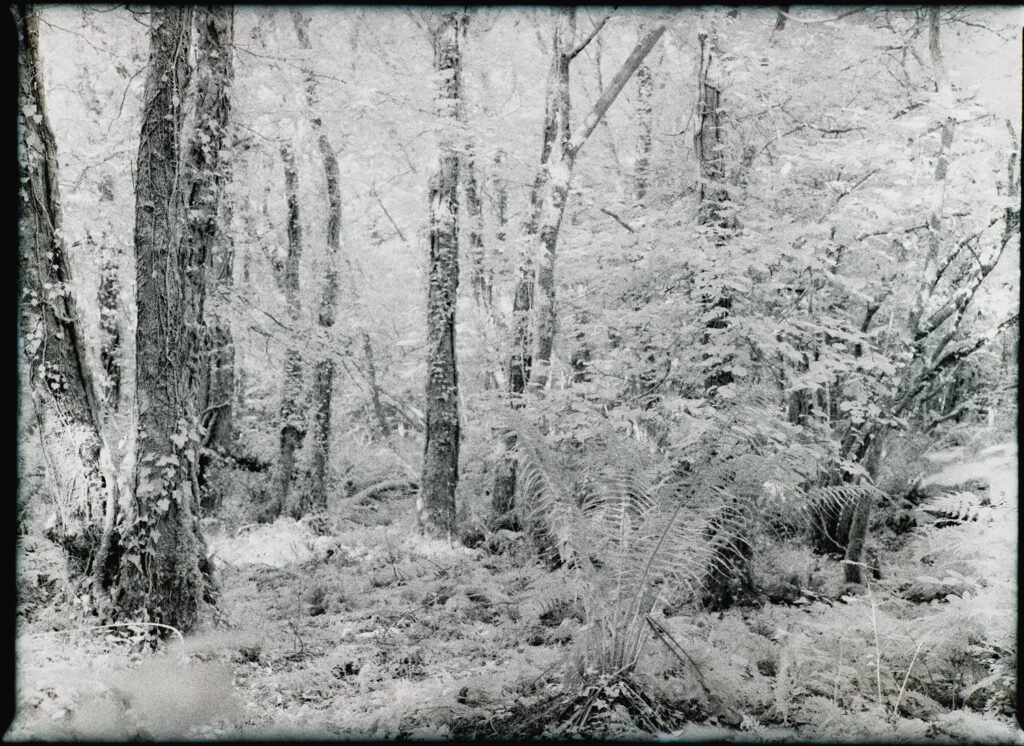
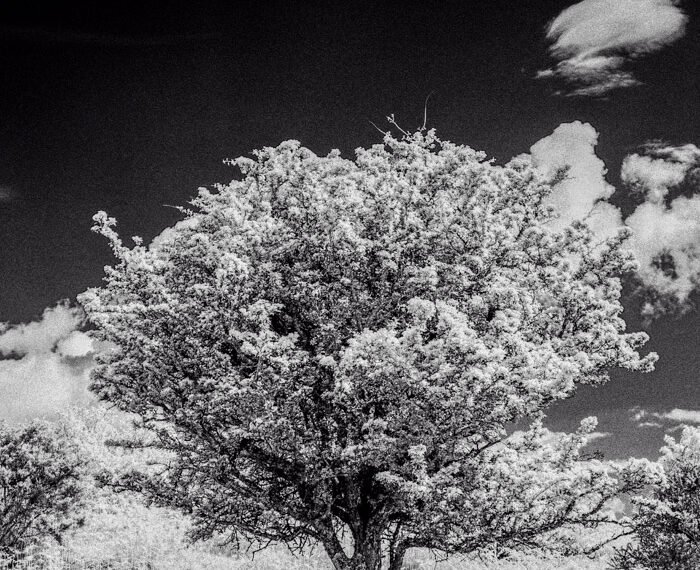
Healthy foliage can become extremely pale, sometimes almost white, while trunks, branches and other objects remain comparatively dark. A woodland you know well can suddenly become somewhere slightly unfamiliar.
That’s what interests me about infrared photography.
I’m not particularly interested in using infrared simply as an effect. What fascinates me is its ability to shift reality just enough that somewhere familiar starts to feel like somewhere else.
Woodland seems particularly suited to it.
The location for this roll is somewhere I already know well. In spring there are bluebells. Later in the year, the woodland floor becomes dominated by ferns.
Through an infrared filter those ferns become something entirely different.
Fifteen Photographs
I was using my Mamiya 645 Pro with the Sekor C 80mm f/2.8 N lens.
One of the things I’m increasingly enjoying about medium-format film is the limitation it imposes. With the 645 format I get just fifteen photographs from a roll of 120 film.
On this particular day I managed to reduce that number even further.
The Mamiya’s power winder had an irritating habit of firing when I didn’t intend it to, wasting a couple of frames. The cable-release adaptor wasn’t much better, repeatedly trying to detach itself from the camera.
Both problems have subsequently influenced how I’ve configured the Mamiya.
I’ve replaced the power winder with a manual crank, which suits the slower way I use the camera far better.
But something interesting happened when I realised how few frames I had left.
I became more selective.
Instead of photographing everything that looked vaguely promising, I started asking myself whether a composition was genuinely worth using one of the remaining frames.
I’ve described this elsewhere as limitations being liberating, and I’m increasingly convinced of it.
Fifteen photographs sounds restrictive when compared with a digital camera and a memory card capable of holding thousands.
In practice, I’m beginning to find the opposite.
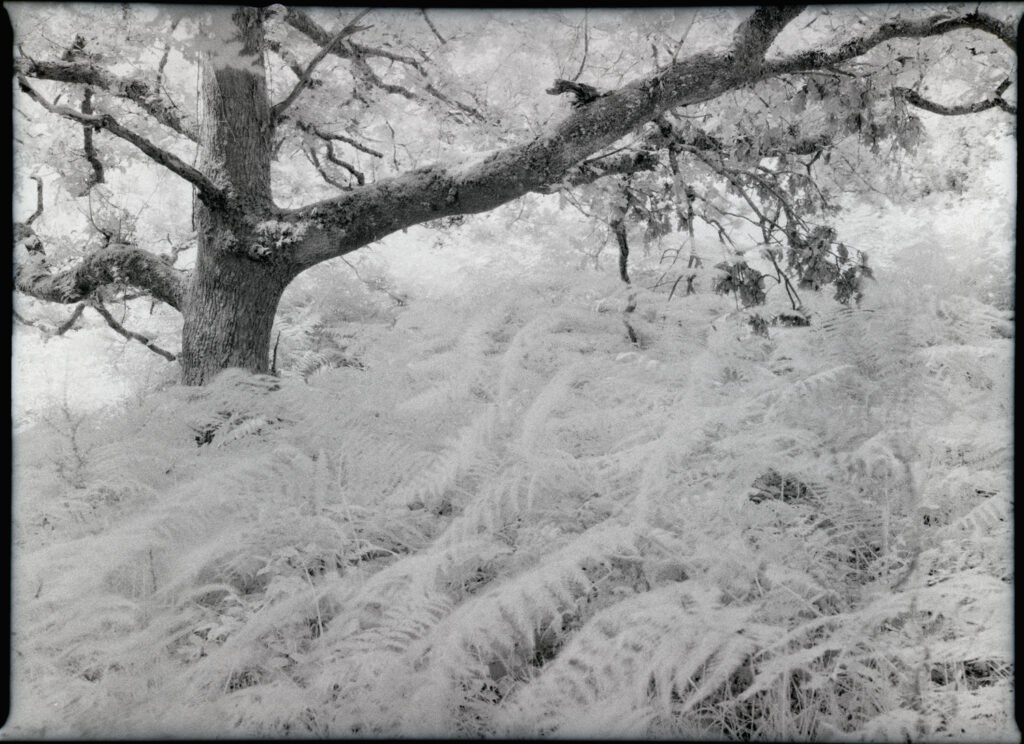
The Old Oak
One of my favourite photographs from the roll is also one of the simplest.
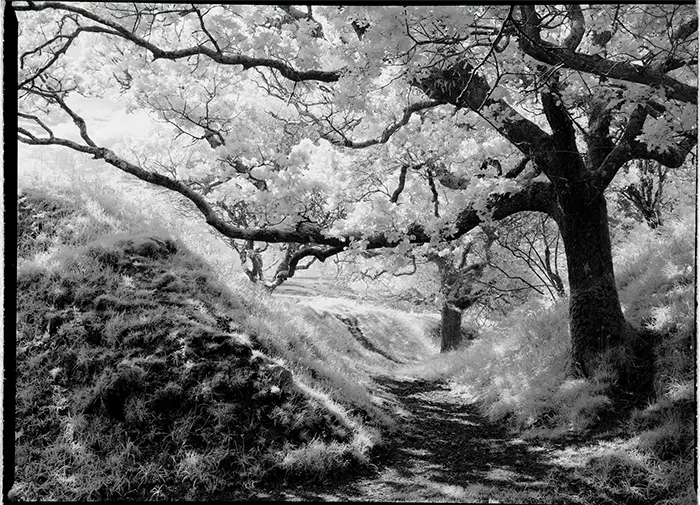
An old oak dominates the left side of the frame, with one enormous branch reaching almost completely across the photograph. Beneath it is a carpet of ferns.
Without infrared it would still have been an attractive woodland scene.
Infrared changes the relationship between everything in it.
The ferns have become incredibly pale and delicate, while the oak remains dark, heavy and textured. I like the contrast between that enormous physical structure above and the almost luminous vegetation beneath it.
It still looks like a woodland.
Just not quite the woodland that was actually in front of me.
That’s the point at which infrared becomes interesting to me.
A Path into Darkness
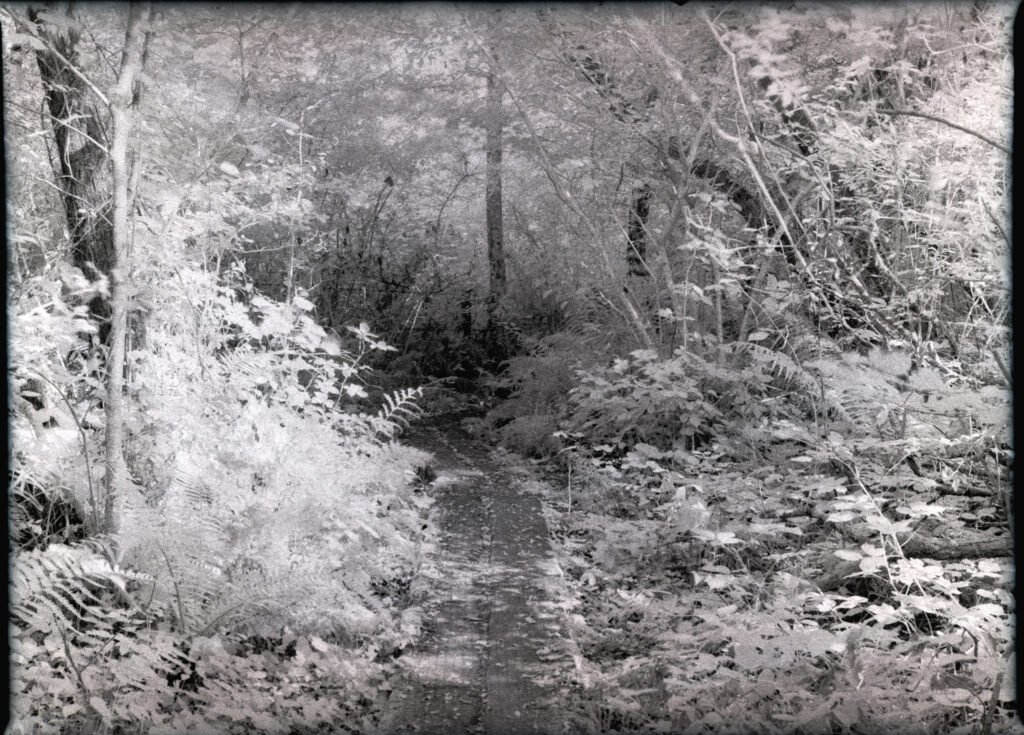
Another photograph follows a woodland path towards a darker area between the trees.
Paths are hardly unusual subjects in landscape photography. They provide an obvious way of leading the eye through a photograph.
But quite often they lead somewhere bright — sunlight, a clearing or some obvious visual destination.
This one doesn’t.
The path disappears into darkness.
Oddly, I don’t find that threatening. If anything, I find it quiet.
I’ve subsequently considered cropping the photograph because there are elements towards the left side that I find slightly distracting, but the version shown here is the complete frame.
In fact, all three photographs accompanying this article are uncropped.
Apart from converting the camera-scanned negatives in Negative Lab Pro, I haven’t adjusted the exposure, contrast, highlights or shadows.
There is a reason for that.
I Got It Wrong
When the negatives finally arrived, I discovered I’d made a fairly substantial mistake.
Some of my long-exposure calculations were wrong.
Very wrong.
A number of the negatives were massively overexposed.
My initial reaction was predictable. After waiting nearly six weeks to see them, discovering that I’d apparently ruined several photographs wasn’t exactly encouraging.
But then I scanned them.
And something unexpected happened.
I liked some of them.
The excessive exposure had pushed the infrared rendering much further than I’d intended. Vegetation became extraordinarily bright, some of the normal tonal separation disappeared and parts of the woodland began to look almost dreamlike.
Technically, they were wrong.
Visually, I wasn’t so certain.
One of the things digital photography has perhaps encouraged is the idea that we should immediately correct mistakes. Highlights can be recovered, shadows opened, contrast adjusted and distractions removed.
I could have done that here.
I deliberately didn’t.
These photographs are essentially what was recorded on the negatives, apart from the conversion from negative to positive.
I wanted to see the mistake.
When a Mistake Becomes Useful
I’m certainly not suggesting that exposure suddenly doesn’t matter.
Some of the photographs were simply overexposed.
But others showed me something I hadn’t intended to create.
That’s useful.
Rather than asking only, “How do I stop this happening again?”, the more interesting question became:
What exactly do I like about what happened?
If I can understand that, perhaps I can reproduce some of those characteristics deliberately.
That’s very different from pretending the original mistake was intentional.
It wasn’t.
I miscalculated the exposure.
But photography would become rather dull if every mistake had to be discarded simply because it didn’t match what we’d planned.
Sometimes the accident points somewhere more interesting.
Roll Three
This was only my third roll since returning seriously to medium-format film, and I’m beginning to realise that these early rolls aren’t simply producing photographs.
They’re changing the way I photograph.
I’m learning how the Mamiya 645 Pro wants to be used. I’m changing the camera to suit me rather than adapting myself to accessories I don’t particularly like. I’m learning how different films behave when I scan them myself. And I’m becoming increasingly comfortable with not knowing exactly what I’m going to get.
The long wait for these negatives was frustrating, particularly when a later roll had already been photographed, processed and returned before these arrived.
But perhaps the delay also emphasised something I’ve started to enjoy about film.
There is a gap between taking the photograph and seeing it.
You remember what you think you photographed.
Then eventually the negative arrives and tells you what you actually photographed.
Sometimes the two are remarkably close.
Sometimes they aren’t.
And occasionally, as happened with this roll, the difference between them is considerably more interesting than getting everything right.
The next roll of infrared film won’t be about avoiding this mistake completely.
It will be about understanding it.
And perhaps making a better version of the wrong photograph.
Leave a Reply