I recently posted a video about my experience using the Mamiya 645 Pro. I meant to write about the camera sooner, but time and other jobs ran away with me. Anyway, here goes—bear in mind this is not a technical review, just my experience using the camera for the first time.
After my joyful experience using the Voigtländer Bessa R, I thought it would be good to try medium format film photography again. My last film camera was, in fact, a Mamiya 645E, so it’s fitting that I’ve almost come full circle in getting the Mamiya 645 Pro. Although, if I’m completely honest, I wanted a Hasselblad 501CM—but my budget would never stretch to that and a lens.
My Mamiya Pro came from eBay with an 80mm lens. It also included a motor drive and a metered prism viewfinder. Now, I am not a fan of a motor drive, and I will get a manual advance when funds allow—but more on that later. The other thing I’m not a fan of was the proprietary cable release, which meant I had to either use an expensive cable or source an adapter to use a regular release. I chose the latter, although the adapter was quite hard to source and relatively expensive for what it is.
I chose to load the camera with Ilford HP5, as I was very familiar with this stock following my previous shoots, and I also purchased a yellow filter to add a little contrast to the sky.
Location-wise, I chose my favourite beach, Ayrmer Cove. It’s a short drive from my house, has a car park with only a short walk to the beach, and is usually fairly quiet.
I spent a good 15 minutes looking for a location to shoot. As the conditions were very blowy, I didn’t want to get as close to the sea as I would normally choose because of the sea spray. I actually took the first frame handheld, and I concede that the motor drive made the camera fairly easy to handhold.

Once I found a location and set up the camera, I attached the cable release, composed a bit more, removed the dark slide, and then pressed the shutter. This is where my first problem occurred—and one of the reasons I’m not a fan of motor drives. The cable release was set to lock, so when I depressed the shutter, the camera kept firing and the motor drive kept winding. I wasted seven frames before I could react. When you only have 15 frames, that’s a lot of wastage. Despite that, the resulting photos were good, although compositionally mediocre.
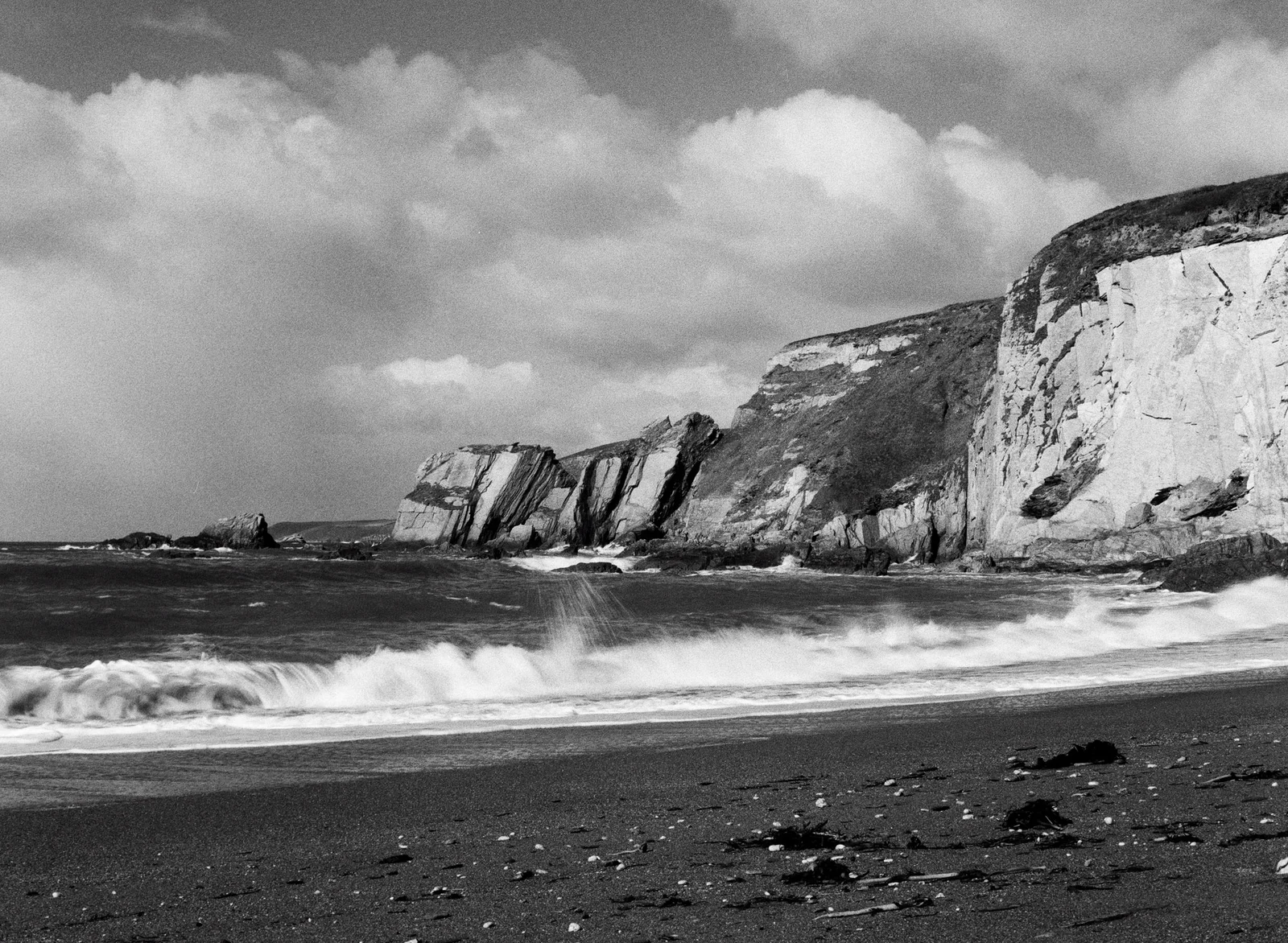
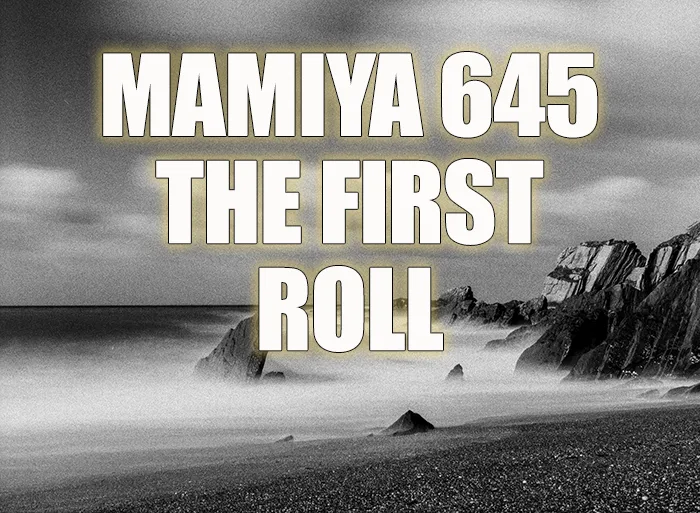
Now, I was feeling brave—I wanted to do a long exposure photograph. I never really did that in my film days—well, actually, I never did. Film doesn’t respond like digital; it doesn’t respond linearly, and you have to take into account reciprocity failure. For Ilford HP5:
Secs = Metered Secs^1.31 (this can be found on the Ilford data sheet).
So my 17-second meter reading actually required a 42-second exposure. To get the 17-second reading, I had nine stops of ND filter on my camera.
For my first long exposure on film, I am very happy with the result—especially as I consider myself a newbie when it comes to film.

Overall, I had a good day with the Mamiya 645 Pro, despite my gripes with the motor drive. Thankfully, the camera is modular, and this can easily be changed, along with the viewfinder and film backs if required.
I must say, though, I was disappointed with the scans I got back from the lab, as they were lower resolution than my 35mm scans from the same lab. This is a case of me needing to set my expectations, as it seems this is the case for all labs. I will just have to factor in drum scans for any images I consider portfolio-worthy—none of these photos are.
Next: a roll of Portra 400—coming soon.

Leave a Reply