Fifteen Frames in an Ordinary Wood
A Mamiya 645, Kodak Portra 400 and absolutely no expectation of making anything special.
Some places make you want to photograph them.
Lambridge Woods isn’t really one of them.
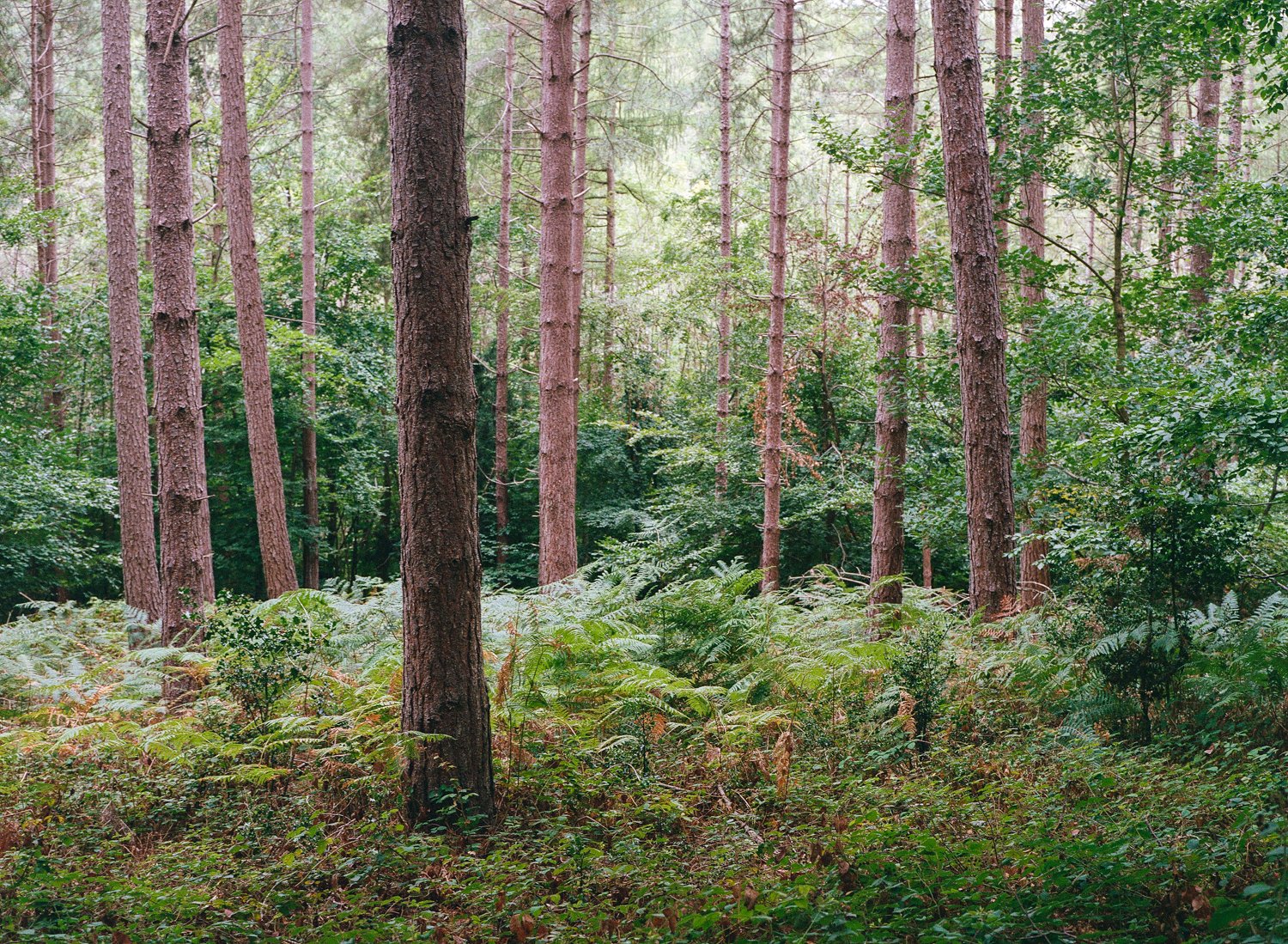
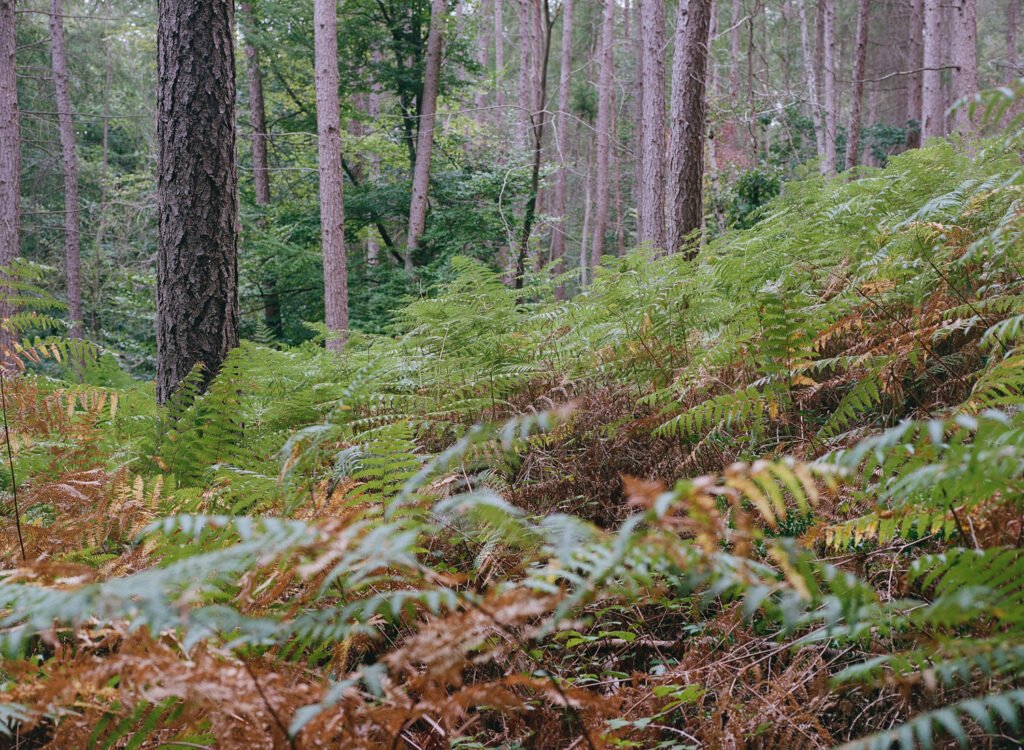
That sounds unnecessarily cruel because it’s a perfectly pretty woodland. There are tall pine trees, ferns, narrow paths and plenty of green. It’s a lovely place to walk.
But pretty and photogenic aren’t necessarily the same thing.
Nothing immediately announces itself as the photograph.
Which was precisely why I went there.
I was staying near Henley for the weekend and had my Mamiya 645 Pro with me. Inside it was a roll of Kodak Portra 400 that had been sitting around waiting to be used.
More importantly, I had a question I wanted to answer about light meters.
I wasn’t going into the woods to make photographs for my portfolio.
I was going there to burn a roll of film.
That distinction turned out to matter.
Three different answers to a simple question
I’d been getting different exposure readings depending on how I measured the light.
The Mamiya has its own meter. I also had my Sekonic Zoom Master L-508 and a free light-meter app on my Android phone.
The difference wasn’t small.
In the consistent overcast light of the woods, at f/8 the Mamiya was telling me 1/60 second.
The Sekonic was also telling me 1/60.
The phone app was suggesting approximately 1/13 second, which meant 1/15 on the camera.
That’s about two stops difference.
I wanted to know which one I could trust.
The conditions were almost perfect for finding out. It was overcast, humid and, most importantly, the light wasn’t changing every few seconds.
I used the Sekonic’s spot meter to take readings from representative midtones, often aiming at the woodland floor.
The Mamiya and Sekonic repeatedly agreed closely enough that I was comfortable trusting the camera for the rest of the roll.
The phone went back in my pocket.
Test largely completed.
But I still had film in the camera.
Now I had to find something to photograph
This was where the afternoon became more enjoyable.
I’d already achieved what I’d gone there to do.
There was no pressure to find a spectacular landscape because there wasn’t one.
No mist was going to suddenly roll between the trees.
There wasn’t a lone tree waiting for the sun to illuminate it.
There wasn’t even much sunlight.
There were just woods.
So I started photographing them.
I had the Mamiya 645 Pro and its 80mm f/2.8 lens. I hadn’t brought another lens.
Normally it’s very easy to look at a scene and think:
That needs something wider.
Or:
If only I had a telephoto.
I don’t remember thinking either.
I had an 80mm lens, so I looked for photographs that worked with an 80mm lens.
That was that.
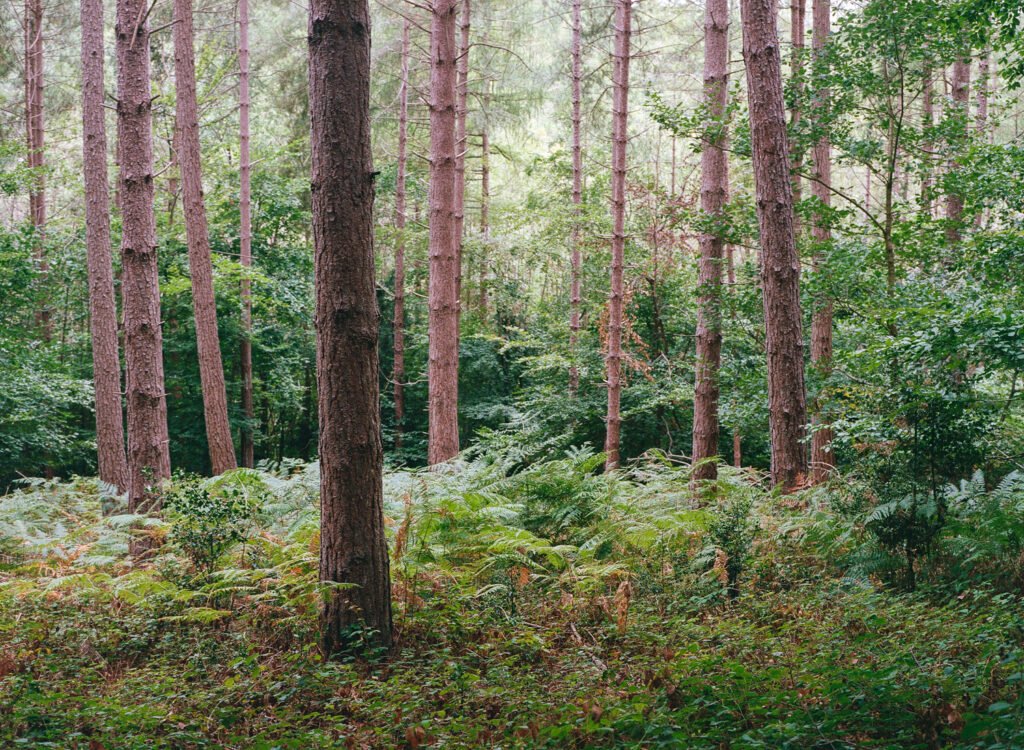
Fifteen frames
One of the things I’m increasingly enjoying about medium-format film is the finite nature of it.
The Mamiya gives me fifteen frames.
Not 150.
Not 500.
Fifteen.
Actually, on this occasion one of those was wasted on a deeply questionable selfie, so perhaps fourteen is more accurate.
Either way, there’s no incentive to make twenty nearly identical photographs just in case one is marginally better than the others.
You look.
You compose.
You focus.
You take the photograph.
Then you move on.
I’m not suggesting that makes every frame meaningful. It doesn’t. I can make rubbish photographs just as efficiently on film as I can digitally.
But it changes the rhythm.
The tripod problem
I was using my lighter travel tripod and initially had everything working as intended.
Camera mounted.
Composition found.
Mirror up.
Cable release.
Then I lost the little adapter that allows me to connect the cable release to the Mamiya.
Bugger.
Now I had to physically press the shutter button.
That shouldn’t have been particularly dramatic, except the woodland floor was soft and I could see the tripod flex slightly when I touched the camera.
I’d gone to the trouble of raising the mirror to avoid vibration and was now potentially introducing vibration with my finger.
There wasn’t much I could do about it.
I took the photographs.
Fortunately, looking at the results, I can’t see any obvious loss of sharpness.
Another lesson learned.
Tripod stability isn’t just about buying a sturdy tripod.
You also have to consider what you’ve stuck its legs into.
I nearly photographed everything horizontally
There was another bit of laziness creeping in.
I was tempted to shoot the entire roll in landscape orientation.
Turning the Mamiya vertically on a normal tripod head is a bit of a faff. The camera hangs over to one side and everything suddenly feels less balanced.
An L-bracket would solve it.
Alternatively, Father Christmas could bring me an RB67 with a rotating back.
I’m keeping both options open.
Fortunately, I stopped being lazy.
A couple of scenes clearly worked better vertically, so I turned the camera.
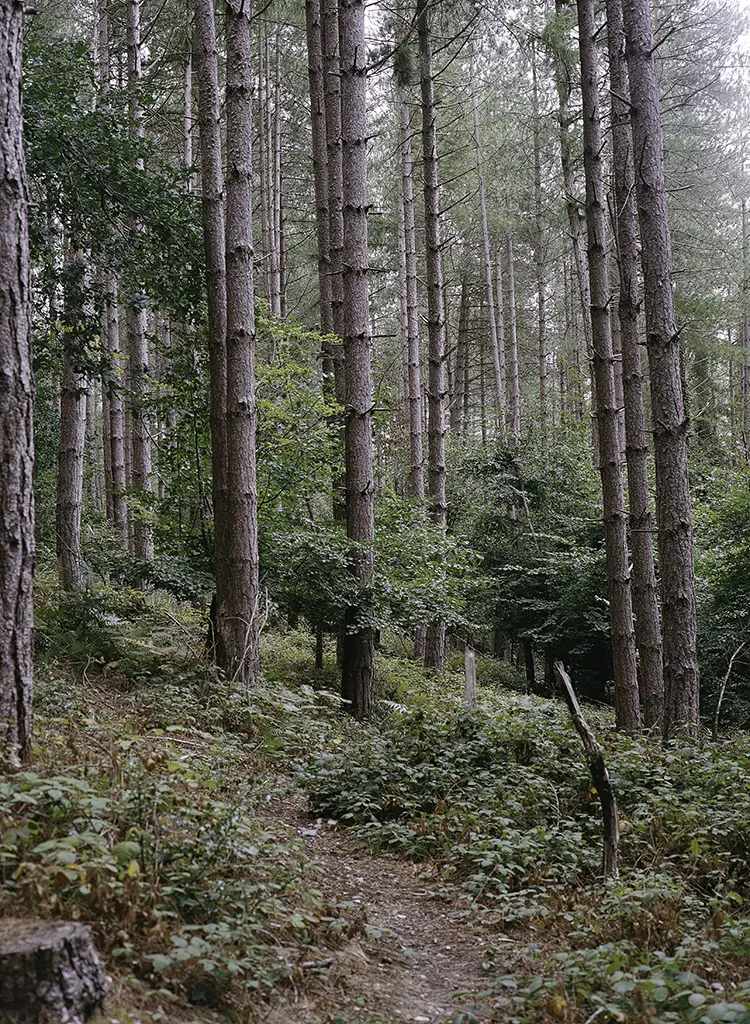
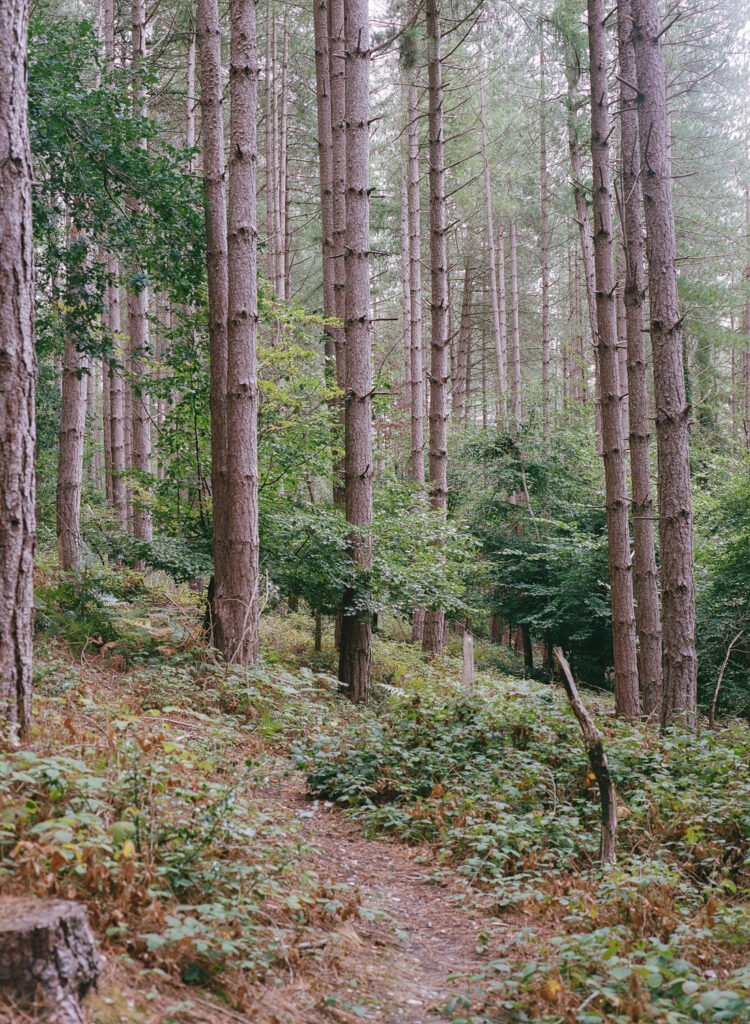
And inevitably, my favourite photograph from the entire roll is vertical.
It’s the photograph looking along the narrow path.
Tall pine trunks fill the frame and the path winds quietly away through the middle of them.
There’s no spectacular subject.
Nothing dramatic happens.
It’s just a path through some trees.
I really like it.
Kodak Portra 400
I’d used Portra once before in a 35mm camera a couple of years ago, but this was the first time I’d really gone out intending to discover what I thought of it.
I’ve spent much more time with black-and-white film recently.
That wasn’t some grand artistic decision. The summer and the subjects I’ve been photographing simply seemed to suit it, particularly with the infrared experiments I’ve been doing.
But I’d kept seeing colour photographs made with Kodak Portra that I loved.
Not necessarily portraits.
It was the landscapes, streets and architecture that interested me.
Beautiful greens.
Soft colours.
Creamy highlights.
Nothing too aggressive.
That’s essentially what I got from Lambridge Woods.
The photographs don’t scream colour at you.
The greens look like greens.
The browns look like browns.
The pine trunks have lovely subtle pink and muted red tones running through them.
Everything is rather easy on the eye.
I think that’s the best description I can give it.
It doesn’t look like digital
That doesn’t mean it looks better.
I’ve become increasingly bored with the argument about film versus digital.
They’re different.
That’s enough.
If I’d taken my GFX into these woods, I’d have produced files containing an extraordinary amount of information. I’d have had complete control over the colour and could have taken as many photographs as I wanted.
The Mamiya gave me fifteen.
And each one cost money.
From a purely rational point of view, digital wins before I’ve even got the Mamiya out of the bag.
But I don’t need film to win.
I just need it to give me a reason to use it.
And it does.
There’s a softness to the feeling of these Portra photographs that I like. Not a lack of sharpness — they’re plenty sharp enough — but something in the colour and contrast feels gentler.
Could I reproduce it digitally?
Probably.
But then I’d be sitting at a computer trying to make a digital photograph resemble something I could simply go out and use.
Frame fourteen
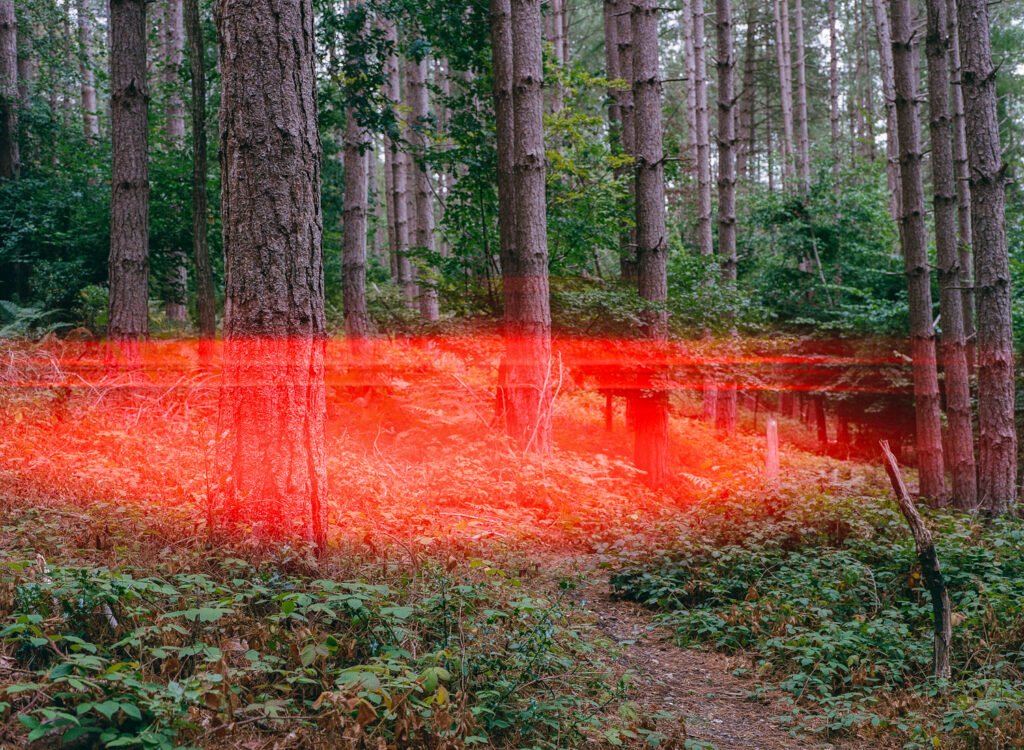
And then frame fourteen exploded.
A huge red streak cuts horizontally through the woodland.
It’s a light leak.
I have absolutely no idea where it came from.
The photograph immediately before it is fine.
The photograph immediately after it is fine.
I’ve never had a light leak from the Mamiya before.
Had it been the first frame or the final frame, I’d probably blame myself for doing something stupid while loading or unloading the film.
But the second-to-last frame?
No idea.
Perhaps there was something wrong with the film.
Perhaps I did something.
Perhaps the Mamiya decided fourteen perfectly sensible frames were enough.
Film occasionally gives you an answer to a question you never asked.
I’m not going to try to rescue the photograph.
It’s part of the roll.
Things I didn’t bring
I didn’t use any filters.
Looking at the results, I wish I’d experimented with a polariser.
The woods were humid and there’s quite a lot of reflected light coming from some of the leaves. A polariser might have taken some of that glare away and given the colours even more depth.
But I’m not particularly bothered that I didn’t.
There will be another roll.
That’s another thing I’m starting to enjoy about this.
I don’t have to solve everything at once.
One roll can lead to another question.
Then another roll can answer it.
Or fail spectacularly to answer it and give me three completely new questions instead.
Learning the Mamiya
I’m also slowly removing little annoyances from the way I use the camera.
I’d previously managed to waste frames while using the power winder.
With only fifteen photographs available, that’s irritating.
This time I was much more careful with the dark slide and the way I handled everything, and apart from my intentionally wasted selfie, I didn’t lose frames through operating the camera incorrectly.
I’ve since bought a manual winding crank.
Hopefully that removes another unnecessary complication.
The more familiar the camera becomes, the less I have to think about the camera.
That’s where I want to get to.
I don’t want using film to become some ceremonial process where every action is performed because this is how proper film photographers work.
I just want to photograph things.
Maybe autumn will be colour
I don’t think this roll has converted me from black and white to colour because I don’t think I needed converting.
I’ve simply happened to shoot more black-and-white film this summer.
If we get a proper autumn this year, that may change.
Portra 400 in autumn woodland could be lovely.
I’d also like to take it somewhere completely different.
Valencia immediately comes to mind.
Strong sunlight, blue skies, the beach and the extraordinary architecture around the City of Arts and Sciences feel almost made for the colours I’ve seen from Portra.
Perhaps I’ll take the Mamiya.
Perhaps I’ll take nothing but the 80mm again.
There’s something rather appealing about that.
But that’s another roll.
An ordinary photograph
I went into Lambridge Woods to test a light meter.
I came back knowing which meter I trusted, knowing that I liked Kodak Portra 400 considerably more than I’d expected, and with fourteen woodland photographs plus one extremely questionable selfie.
None of them needed to exist.
My favourite remains the vertical photograph of the path.
There isn’t anything remarkable in it.
A narrow trail disappears between straight pine trunks. Ferns and brambles cover the ground. There is no spectacular light, no mist and no solitary tree perfectly positioned against the horizon.
It’s simply what was there.
Perhaps that’s why I like it.
Increasingly, film seems to be teaching me that going out to make a photograph and going out to photograph aren’t quite the same thing.
I think I prefer the second.