I Nearly Discounted My Favourite Photograph of the Year
Sometimes you know you like a photograph before you really know why.
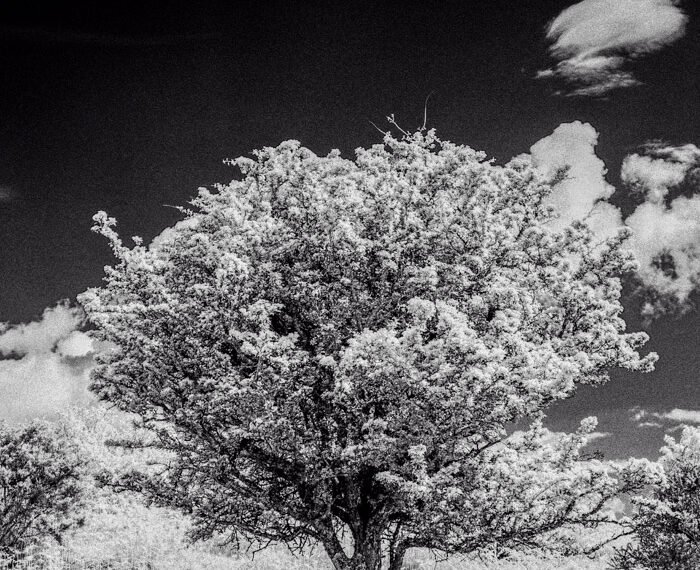
That was certainly the case with this tree.
I had been experimenting with Rollei Infrared 400 in my Mamiya 645 Pro, and to say the results had been mixed would probably be generous. Infrared film introduces another layer of uncertainty into something that already has plenty of opportunities to go wrong. Some of my exposures were simply wrong, and a few of the negatives looked so dense that I wondered whether there was anything useful on them at all.
But this photograph was different.
As soon as I saw the composition, I liked it.
There was something about the shape of the tree and the way it sat within the landscape that immediately appealed to me. The infrared film had separated it from its surroundings in a slightly unreal way, and the whole thing reminded me of a Japanese ink painting.
The branches seemed less like branches and more like brushstrokes.
It was simple, quiet and slightly strange.
Exactly the sort of photograph I tend to like.
And then I looked at the scan.
When the Technical Stuff Gets in the Way
The scan I’d received back from the lab was disappointing.
It was very grainy and appeared heavily sharpened. Rather than the gentle tonality I thought might be in the photograph, everything felt hard and slightly brittle.
And I nearly discounted the image because of it.
That’s the strange part looking back at it now.
I hadn’t stopped liking the composition. I hadn’t suddenly decided the tree was in the wrong place or that I should have taken the photograph differently.
I still liked the photograph.
What I had started questioning was whether it was technically good enough.
There is probably something slightly ridiculous about that.
We spend so much time as photographers thinking about sharpness, resolution, grain, dynamic range and all the other things that can be measured or examined at 100% that sometimes those things begin to have more influence over us than the photograph itself.
I was in danger of doing exactly that.
Going Back to the Negative
Fortunately, I didn’t quite give up on it.
I put the negative on a light table and looked at it through a loupe.
That changed things.
The negative didn’t seem to have the same harsh character as the scan. There appeared to be much more information there: more subtlety, more tonality and detail that simply wasn’t being represented particularly well in the digital file I had been looking at.
That was when I started wondering whether I was judging the photograph or judging the scan.
They aren’t necessarily the same thing.
I should probably add that this doesn’t mean all my problems with that roll were caused by scanning. They weren’t.
I definitely got some of the exposures wrong.
In fact, one of the things that has surprised me most while experimenting with scanning the negatives myself is just how much information film can sometimes retain even when I’ve made a mess of the exposure. I had negatives that looked almost black, yet with a sufficiently long scanning exposure I was able to pull a perfectly usable photograph from them.
Film had considerably more latitude than I had given it credit for.
But the tree wasn’t really about rescuing a bad exposure.
It was about discovering that the photograph I already liked was better than the first scan had led me to believe.
Seeing the Photograph Again
I eventually started scanning some of the medium-format negatives myself.
I won’t go into all the equipment and process here because that’s really another subject. The important thing was that I could take my time with an individual negative and see what was actually there.
When I rescanned the tree, I finally got something much closer to the photograph I felt I’d taken.
The aggressive-looking grain wasn’t dominating everything. The tonal transitions were much more subtle. There was detail without the photograph feeling as though every tiny piece of it had been sharpened to demand my attention.
Most importantly, the tree was allowed to be the tree again.
And that Japanese painting quality I’d liked from the beginning was still there.
In fact, I could see it more clearly.
Perhaps I Was Looking at the Wrong Thing
The whole experience has made me think about how easily we can talk ourselves out of liking our own photographs.
Sometimes that’s useful.
Time is a very good editor, and I’ve certainly taken photographs that I’ve initially been excited about only to wonder a few weeks later what on earth I saw in them.
But this was different.
I liked this photograph and then nearly rejected it because I thought there was something technically wrong with it.
That’s quite an important distinction.
Photography has become extraordinarily technical. Even with film, which is supposedly where we escape all this stuff, we eventually turn the negative into a digital file and suddenly we’re back looking at pixels, sharpness and noise on a computer screen.
It becomes very easy to ask:
Is it sharp enough?
Is there too much grain?
Did I get the exposure exactly right?
All perfectly reasonable questions.
But perhaps they shouldn’t be the first questions.
Maybe the first one should simply be:
Do I like this photograph?
With the tree, the answer had always been yes.
My Favourite Photograph of the Year?
I’ve taken quite a lot of photographs this year with cameras that are technically capable of producing files vastly superior to anything that could come from this particular piece of infrared film.
And yet I keep coming back to this tree.
It may well be my favourite photograph I’ve made this year.
Not because it’s technically perfect. I’m not even particularly interested in deciding whether it is.
I like the simplicity of it.
I like the slightly unreal quality the infrared film has given the landscape.
Most of all, I like that tree.
It still reminds me of a Japanese painting: a few carefully placed brushstrokes describing something rather than trying to reproduce every detail of it.
And perhaps there’s a useful lesson for me in the fact that I nearly discounted it.
The lab scan wasn’t what I hoped it would be. Some of my exposures on the roll were wrong. I’ve spent far more time than expected experimenting with negatives, scanning and trying to understand what I’m doing.
But somewhere amongst all of that was this photograph.
I saw something when I pressed the shutter.
I liked it when I first saw the composition.
And after all the technical distractions, I still like it now.
Perhaps sometimes that’s enough.

Leave a Reply